
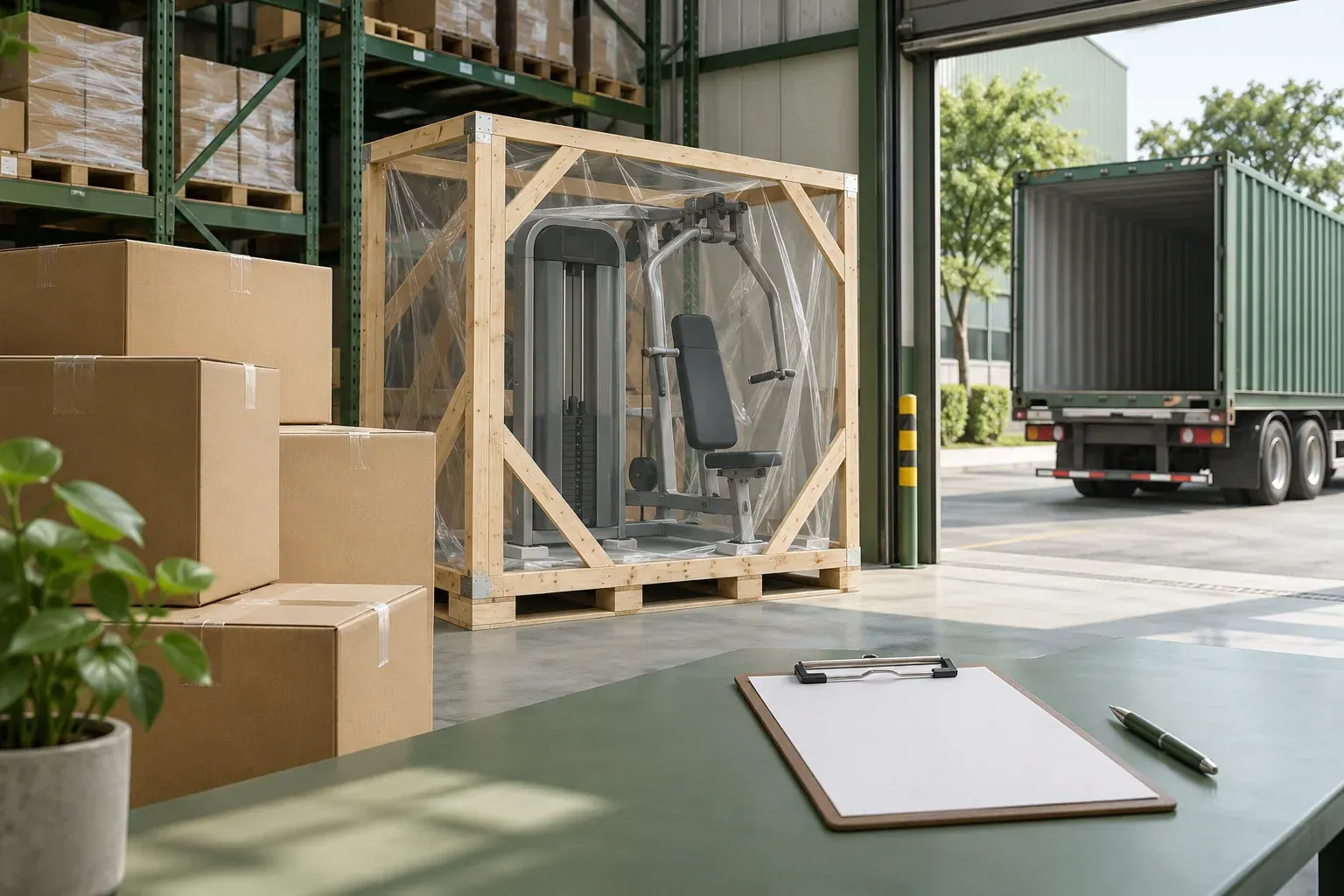
Importing gym equipment from China can help a gym, studio or distributor buy products for a project. But an overseas order raises extra questions. Do both quotes include the same parts? Who handles customs paperwork? Who moves a heavy machine from the port to your building?
Start with a written product list before asking for prices. Use this guide to compare suppliers, prepare an inquiry and identify costs. The U.S. examples are a starting point. The rules and duties for your order depend on the product, destination and current requirements.
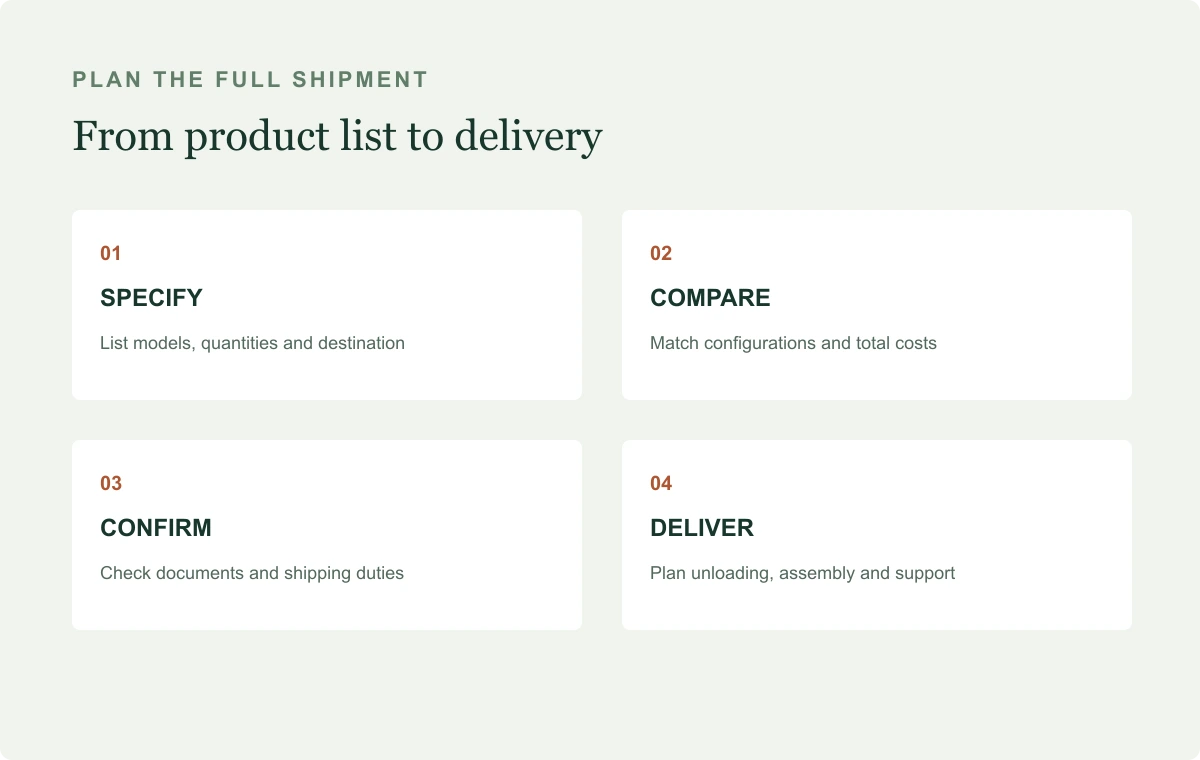
The process: define your products → check the supplier → compare specifications and samples → agree on costs and responsibilities → plan inspection and documents → arrange shipment → prepare delivery and after-sales.
1. Write a product brief for each item
“Gym equipment” is too broad to produce a reliable quote. Give the supplier an itemized list, intended use, quantity and destination. Confirm what counts as one unit and what comes with it.
| Product | Details to clarify before asking for a quote |
|---|---|
| Commercial power rack | Frame dimensions, clearance, steel specifications, load-rating and test basis, safety supports, hooks and anchoring instructions |
| Rubber hex dumbbells | Weight increments, quantity per weight, pieces versus pairs, weight tolerance, material and price unit |
| TPE yoga mat | Length, width, thickness and tolerance, grip requirements, color, logo, individual and carton packaging |
| Folding treadmill | Intended use, running area, user-weight rating, voltage, frequency, plug, motor rating basis, folded dimensions and documentation |
| Size 5 training volleyball | Cover and bladder, target circumference and weight, recommended inflation pressure, intended surface and print requirements |
| Pilates reformer with tower | Installed and packed dimensions, tower and accessories included, springs and resistance information, load rating, assembly and spare parts |
Explore the product information for our commercial power rack, rubber hex dumbbells and TPE yoga mat. You can also review our folding treadmill, size 5 training volleyball and Pilates reformer with tower. Confirm the final model and included parts before ordering. For a closer look at specific orders, read our Pilates reformer wholesale checklist or TPE yoga mat wholesale checklist.
If you need multiple categories, ask whether they can be combined in one order or shipment. Do not assume that every product has the same manufacturer, origin, lead time or warranty.
2. Check who you are buying from and who makes the product
Ask for the seller’s business name and contact details. For each item, ask which factory makes it, and request a specification sheet plus photos or video of the model. If you need a test report or certificate, check the model, issuer, what the report covers and whether it is valid. A badge on a catalog is not enough.
A trading company and a manufacturer can each be useful partners, but their roles should be clear. Ask who can explain the product specifications and arrange inspections. Also ask who will help if parts are missing or damaged.
Gym Equipment World is operated by SONGYAO in Hebei and works with a manufacturing partner in Shandong. Confirm the source factory for each product in your order. One partner does not necessarily make every item in the catalog.
3. Compare quotes and samples on the same basis
Ask each supplier to respond to the same brief. For each line item, request:
- Model or written configuration, included accessories and quantity.
- Price and currency, including whether the price is per piece, pair, set or kilogram.
- Minimum order, sample availability and sample charges, if any.
- Branding or packaging options, setup charges and required quantities.
- Manufacturing lead time and when that period begins.
- Packing method, number of cartons or crates, dimensions and gross weights.
- Quoted trade term, named place and which shipping or destination charges are included.
- Warranty terms, replacement-part availability, manuals and claim procedure.
For example, if one dumbbell quote is per piece and another is per pair, normalize the unit before comparing prices. If two reformers look similar, compare the tower, springs, box and accessories line by line.
Where a sample is available, document what you approve: model, finish, size, packaging and any agreed tests. Ask what differences are permitted in production and how inspection results will be handled.
4. Understand the shipping term—and the rest of the cost
EXW, FOB, CIF and DDP are common Incoterms®: trade rules that help define who handles certain delivery tasks, costs and risks. A quote should name both the place and the Incoterms version. Ask who arranges and pays for each step. These rules do not replace your contract or settle every question about payment, ownership or warranty. See the U.S. International Trade Administration’s Incoterms guide.
| Term | Useful question to ask |
|---|---|
| EXW — Ex Works | Where is the named delivery point, and who will actually handle pickup, export formalities and loading? Check feasibility with the seller and forwarder. |
| FOB — Free on Board | Which named port of shipment is quoted, and what costs arise after the goods are on board? FOB is for sea or inland waterway transport. |
| CIF — Cost, Insurance and Freight | Which destination port, insurance coverage and destination charges are included? Under CIF, carriage and insurance are paid to the named port, while risk transfers when goods are on board at the port of shipment. CIF is for sea or inland waterway transport. |
| DDP — Delivered Duty Paid | What is the named destination, who will act as importer of record, and which duties, taxes, unloading and delivery services are included or excluded? Confirm the arrangement with your broker. |
For containerized or multimodal shipments, discuss with your forwarder whether a rule designed for any mode, such as FCA or CIP, better matches the actual handover. Do not assume that a word such as “door to door” answers every cost and customs question.
Build a landed-cost comparison
Use the same destination for every quote. Landed cost means the total estimated cost to get the goods to the place you choose:
Estimated landed cost = goods + origin and export charges + main freight + insurance + destination handling + duties and taxes + customs/brokerage + inland delivery + installation or other agreed costs.
Only add costs not already included in the quoted price. A lower FOB price can become a higher delivered cost if packing, freight or destination services differ. Ask your forwarder for a written estimate identifying assumptions and possible additional charges.
For U.S. imports, product classification and applicable duties depend on the exact goods, origin and rules in force at entry. Ask a licensed customs broker or U.S. Customs and Border Protection (CBP) to help determine the correct classification and current requirements; avoid applying one “gym equipment tariff” to every product.
Worked example: turn a quote into a delivered estimate
Suppose a buyer imports one mixed equipment order. The following amounts are illustrative only, not market rates or a quotation. In this example the $4,000 goods price already includes origin charges, and all other lines are separate.
| Cost | Example amount |
|---|---|
| Goods, including the agreed origin charges | $4,000 |
| Main freight | $900 |
| Insurance | $100 |
| Destination handling and brokerage | $450 |
| Estimated duties and taxes provided for this example | $550 |
| Inland delivery | $300 |
| Estimated landed total | $6,300 |
The estimate is $2,300 above the goods price. It is not a prediction of your cost: the actual classification, customs value, rates, charges, terms and location may differ. The example includes duties and taxes as a supplied estimate, not as a calculated rate. Check each line with the forwarder or broker and ask which charges could change before the shipment is released.
5. Plan inspection and documentation before shipment
Agree who will perform any inspection, what will be checked, the sampling method, acceptance criteria, how defects will be reported and who pays for any reinspection. Depending on the item, a review might cover quantity, dimensions, visible assembly, labels, included accessories, electrical identification and packing. A photograph or an inspection report is useful evidence, but it does not automatically prove long-term durability or certification.
Ask your seller, freight forwarder and customs broker which documents your shipment needs. A freight forwarder helps arrange transport. A customs broker can help with customs paperwork. Common documents include an invoice, a packing list and a transport document. Other documents may be needed for your goods or destination. CBP lists the information it expects in a commercial invoice or acceptable substitute.
For goods arriving in the United States by ocean vessel, discuss the Importer Security Filing with your broker before loading. CBP explains the filing scope and timing in its guidance for new importers. The party acting as importer of record and the broker's responsibilities should be clear in advance.
For wood crates, pallets or dunnage, ask the forwarder whether the packaging is regulated and what treatment and markings are required for the destination. CBP's wood packaging guidance explains the U.S. rules for regulated material; not every type of packaging is treated identically.
6. Prepare for delivery and support after arrival
Large fitness equipment can create a second logistics problem after customs release. Confirm the delivery point: port, warehouse, curbside or another named place. Ask whether unloading is included and whether you need a forklift, liftgate or extra staff. Measure doors, elevators and corridors against the equipment’s packed dimensions.
Before paying the final balance or accepting the shipment, clarify how to report damage or missing parts, what documentation is needed and which party handles claims. Ask for assembly instructions, a packing list, contact details, replacement-part identifiers and written warranty terms. Installation and on-site service should never be assumed unless specifically agreed.
A copyable request for quotation
Project and destination: [type of facility or resale business; city and country]
Products and quantities: [model, configuration and number of pieces / pairs / sets]
Technical requirements: [dimensions, load-rating basis, voltage, materials, accessories and intended use]
Samples and customization: [sample request, logo, color, packaging and artwork]
Documentation and inspection: [required reports, manuals, acceptance checks and who arranges them]
Shipment: [preferred Incoterms® 2020 rule and named place; requested delivery date and access restrictions]
After-sales: [spare parts, warranty, installation requirements and contact person]
Start with a clear product list
Explore the Gym Equipment World product collection. If you are planning an order, tell us the products, quantities, destination and key technical requirements. We can discuss the available product information and prepare the details needed for a quotation; sourcing, documentation, delivery and after-sales terms are confirmed for each order. Discuss your order.
FAQ
Can different kinds of equipment be shipped together?
Possibly, but it depends on the suppliers, packing, quantities, lead times, destination requirements and freight arrangement. Ask whether all products can be consolidated and who is responsible for each stage.
Do I need a customs broker?
Rules vary by country and shipment. A U.S. importer may choose to use a licensed customs broker for assistance, but using one does not remove the importer's responsibilities. CBP explains this in its [new importer guidance](https://www.help.cbp.gov/s/article/Article-1894?language=en_US).
Is CIF the same as delivery to my gym?
No. CIF names a **port of destination** and includes carriage and specified insurance to that port; it does not automatically include import clearance, duties or delivery to your gym. Confirm destination charges and inland delivery separately.
Which certificates are required?
There is no single certificate that applies to every gym product in every market. Requirements can differ between a powered treadmill and a non-powered mat or rack. Give your broker and supplier the exact product, configuration and destination, then verify any required documents and claims.
How do I request a sample?
Ask whether a sample matching your planned model is available, what is included, its price, shipping cost, lead time and how it compares with production. Sample availability and terms vary by product.