
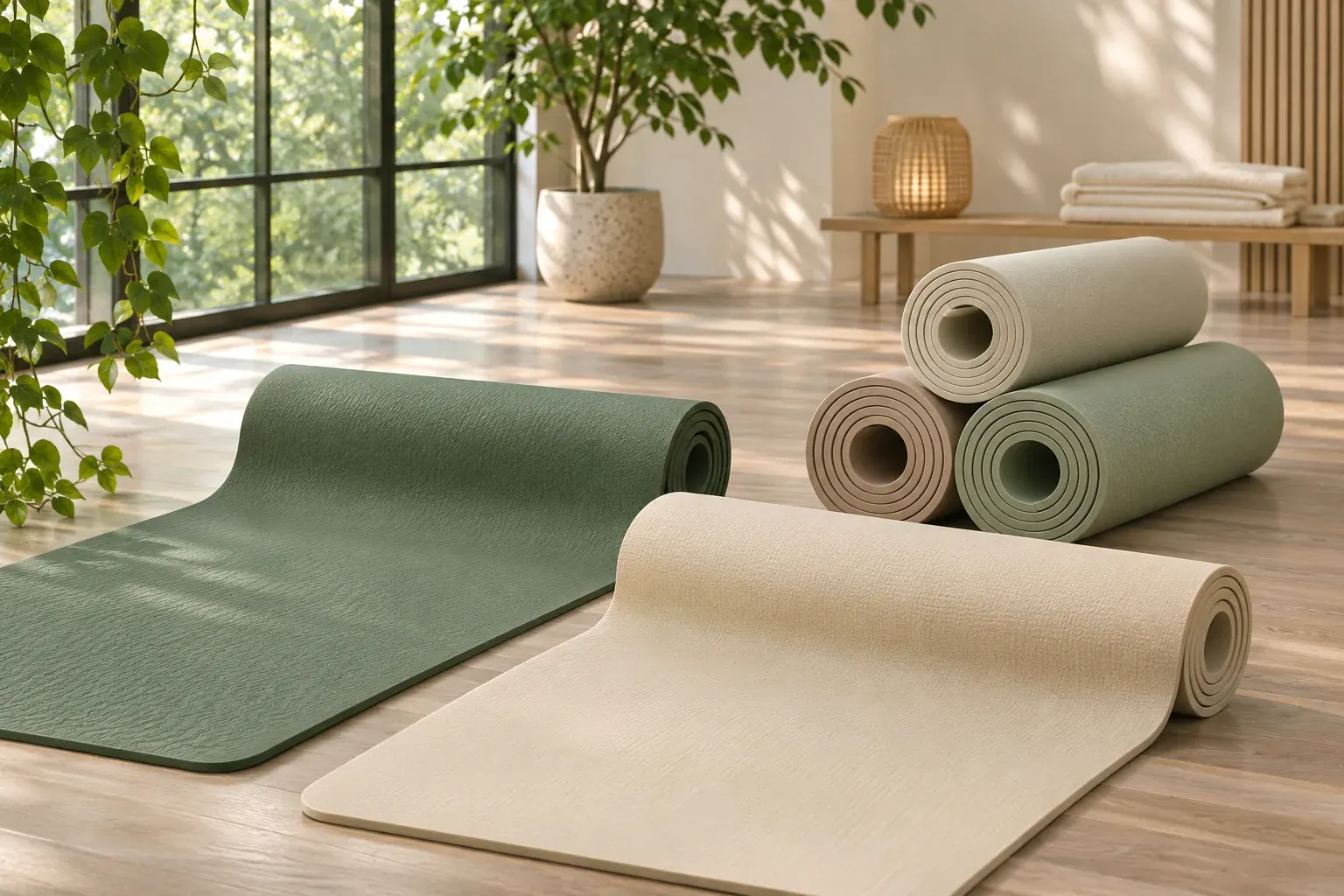
A yoga studio may need mats for daily classes. A retailer may want mats to sell. A brand may need mats printed with its logo. All three buyers may search for “yoga mats wholesale,” but their needs are different.
Before comparing wholesale yoga mats, decide who will use them, how they will use and clean them, and how many you need. Write down any material or safety claims you need to verify. Then ask each supplier for samples and prices based on the same requirements. A lightweight gift mat and a mat for daily studio classes may not be equally suitable.
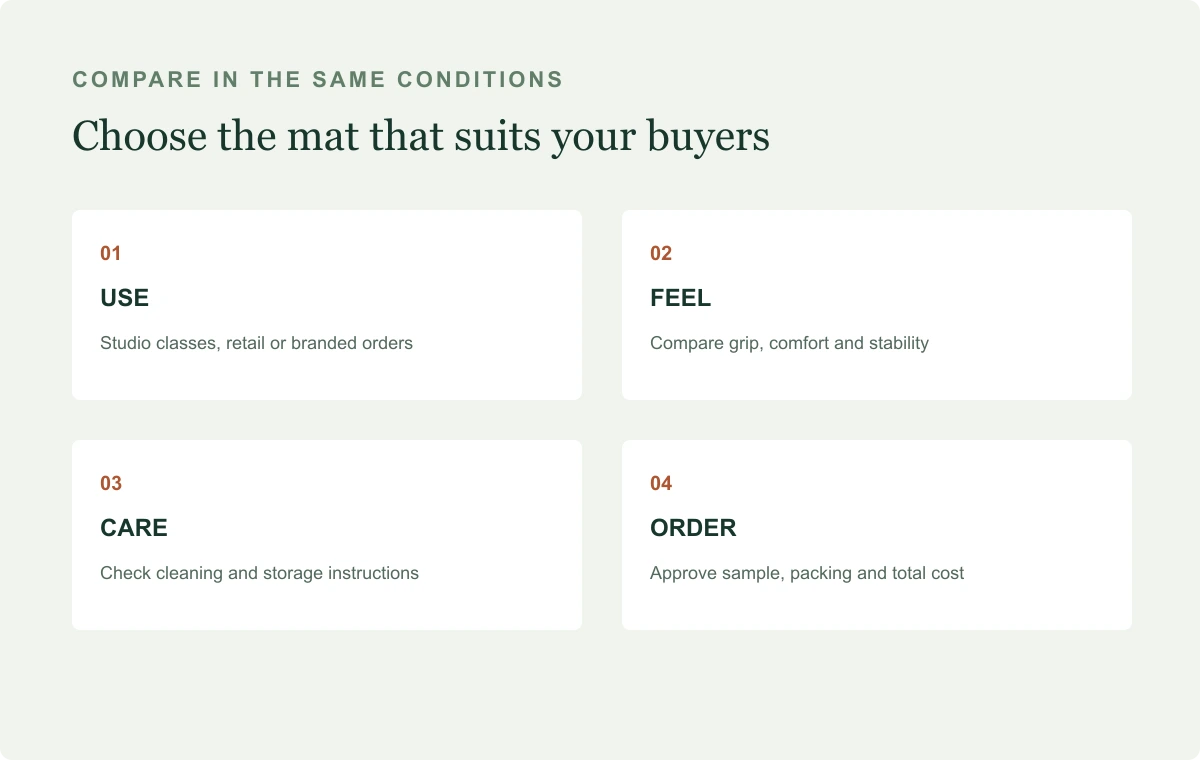
Start with the buying scenario
| Buyer | Typical use | Priorities to discuss |
|---|---|---|
| Yoga or fitness studio | Shared mats used across multiple classes | Grip in class conditions, cleaning compatibility, comfort, storage and replacement planning |
| Retailer or distributor | Resale to customers with different preferences | Size and thickness range, individual packaging, labeling, order consistency and returns terms |
| Brand or event buyer | Branded gifts or promotional merchandise | Logo placement, color matching, sample approval, packing, quantity and delivery date |
Describe the expected environment: room-temperature or heated classes, dry or sweaty practice, hard floors or other surfaces. If an instructor team will use the mats, involve them in sample evaluation before approving a bulk order.
How do you choose TPE yoga mat thickness and size?
TPE stands for thermoplastic elastomer. It is a group of flexible materials, not one fixed recipe. Mats can differ in their surface, structure and density. The word “TPE” alone does not tell you how well a mat grips, how long it lasts or which cleaners it can handle.
Thickness affects both cushioning and stability. A thicker mat may feel more comfortable for floor exercises. For standing and balance, some users prefer a firmer surface that does not sink as much. Material and construction matter too, so try samples instead of choosing by thickness alone. Manduka's mat-selection guide likewise discusses grip, thickness, length and care as separate considerations; its product claims apply to its own mats.
For each sample, ask for:
- Length, width and thickness, including measurement method and permitted tolerances.
- Weight per mat and approximate rolled dimensions for handling and storage.
- Top and bottom surface descriptions; whether both sides are intended for use.
- Packaging per mat and per carton, including carton dimensions and gross weight.
- Available colors and configurations for the quantity you plan to order.
If a supplier lists several thicknesses, confirm which are available for the exact model, color and order quantity. Do not assume every advertised combination is available.
A practical way to choose between sample thicknesses
For example, a studio buying shared mats could ask for two samples of the same material and surface, one around 4 mm and another around 6 mm. These are comparison examples, not a claim that either thickness is available in our current SKU. Have instructors try the same standing and floor-based movements on both, using the same floor and cleaning routine. Record comfort, stability, grip, handling and rolled size; choose the sample that meets the studio's own priorities rather than assuming the thicker mat wins.
A retailer planning to ship individual mats should also compare each sample's rolled diameter, packaged weight and carton count. A more comfortable sample can cost more to store or ship if its packed volume is larger. Ask for the actual packed dimensions and weights before calculating freight.
| If your main priority is… | Compare first | Decide after checking |
|---|---|---|
| Standing and balance classes | A firmer sample against a more cushioned sample | Stability and grip in the intended exercises |
| Floor-based classes | Cushioning alongside surface support | Comfort for users and whether storage remains practical |
| Frequent shared use | Grip, approved cleaning instructions and surface condition | Instructor feedback and how the sample handles the proposed routine |
| Retail or branded orders | Appearance and packed size alongside grip | Approved sample, print, packaging and total cost |
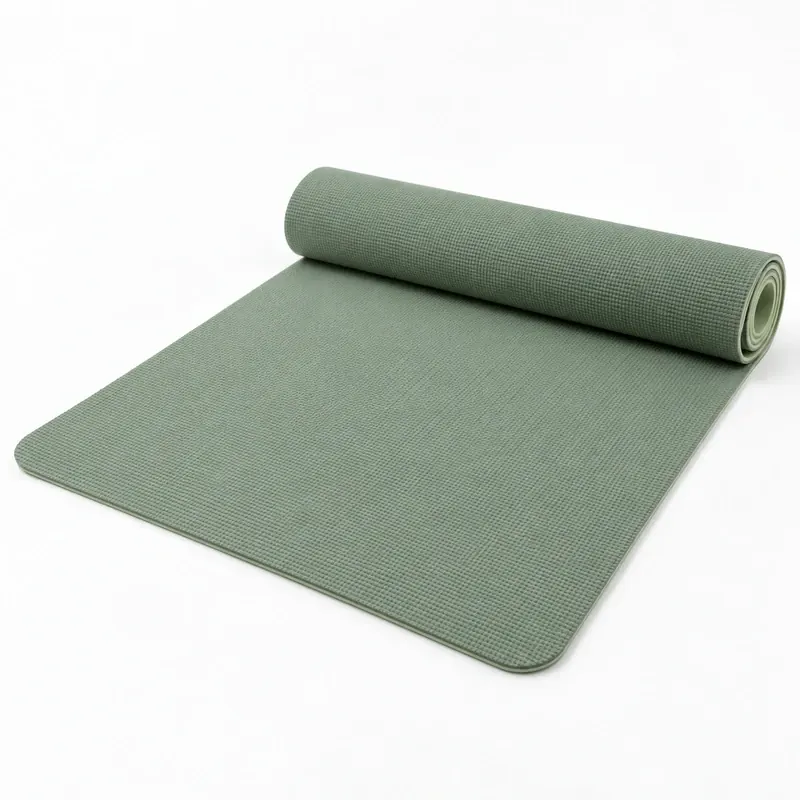
Check grip in the conditions that matter
A mat can feel different under dry hands, sweaty hands and on different floors. Test both the top surface and the underside: you want to understand whether hands and feet slip on the mat and whether the mat moves on the floor.
For a useful sample comparison:
- Test mats on the floor types used in your studio or expected by your customers.
- Compare the same exercises under dry conditions and, if relevant, with light moisture appropriate to the activity.
- Check whether the edges remain flat and whether the mat shifts during transitions.
- Record who tested each sample and their observations using the same conditions.
- Ask for any available test method and report rather than treating a marketing term such as “non-slip” as a test result.
A small in-house comparison helps you choose a sample; it does not prove a universal safety rating. For hot or high-sweat practice, discuss whether a towel is suitable and follow the mat's own instructions. Manduka's guidance notes that some users pair mats with towels in sweatier sessions, but that does not establish the wet-grip performance of another mat.
Verify cleaning, durability and material claims
Shared mats may be cleaned frequently, but a cleaner suitable for one material or surface may not suit another. Ask the supplier for the selected mat's care instructions, compatible cleaning agents and drying or storage recommendations. Test any proposed cleaning routine with a sample and follow the product instructions; do not assume that alcohol, bleach, machine washing or prolonged soaking is appropriate.
Inspect samples for surface damage, color differences, odour and edge finish when they arrive and after normal trial use. If odour matters for an enclosed studio, discuss it before ordering and agree how it will be evaluated. A sample observation does not establish a medical or chemical safety result.
If you want to describe a mat as “recyclable,” “tested” or free from a certain substance, ask for evidence that supports that specific claim. Check that the evidence covers the product and destination market. A material name is not a certificate. Local recycling facilities also accept different materials. The U.S. EPA's guidance on environmental claims recommends looking carefully at vague environmental marketing language.
Compare samples and approve a clear specification
The best way to make competing quotes useful is to ask each supplier for the same target size, thickness, surface, color, quantity and packaging. Mark any differences in the comparison.
| Check | What to agree before the order |
|---|---|
| Dimensions and weight | Measurement method and permitted tolerance for each specification |
| Surface and appearance | Top and bottom finish, color reference and acceptable variations |
| Trial use | Your intended grip and handling checks and who approves the sample |
| Print or logo | Placement, size, artwork, colors, proof and approved sample |
| Packaging | Individual wrapping, labels, mats per carton and carton markings |
| Acceptance | Which approved sample and written requirements the order will reference |
Ask what will happen if a production batch differs from the approved specification. Settle inspection, reporting and resolution terms in the purchase agreement rather than after the goods arrive.
Understand customization, minimums and total cost
A quote for plain stock mats may have different conditions from a custom-color or printed order. Ask the supplier to distinguish:
- Price per mat, currency and quoted quantity; any quantity tiers.
- Minimum quantity per color, size, artwork or packaging design, where applicable.
- Sample, artwork, setup or printing charges and approval process.
- Production time and when it begins, including artwork and sample approval.
- Carton size, gross weight, shipping term and named place.
- Freight, destination charges, duties or delivery costs included and excluded.
If you plan to reorder, ask how color and product specifications will be recorded for future batches. Availability, costs and customization options depend on the product and order; get the details in writing.
Worked example: compare the delivered cost per mat
Suppose a buyer orders 100 mats. The figures below are hypothetical, in U.S. dollars, and are not our quotation. In this example, printing and freight are not included in the supplier's unit price.
| Cost | Supplier A | Supplier B |
|---|---|---|
| 100 mats | $600 | $700 |
| Printing and setup | $150 | $50 |
| Freight and other agreed delivery charges | $250 | $250 |
| Example total | $1,000 | $1,000 |
| Example cost per mat | $10 | $10 |
Both offers cost $10 per mat in this example, even though their starting prices differ. Taxes, duties and other costs are not included. Add them if they apply, but do not count the same charge twice. Before choosing, check that the mats, printing, samples and delivery terms are comparable.
If you are buying from overseas, see our guide to importing gym equipment from China for shipping and document questions.
Copy this wholesale inquiry
Business and application: [studio / retailer / brand; class or resale use]
Estimated quantity: [number of mats and quantity per color]
Target size and thickness: [length × width × thickness; tolerance if known]
Use conditions: [floor surface, normal or high-sweat use, expected cleaning routine]
Sample requirements: [color, surface, packaging and evaluation date]
Customization: [logo size and placement, artwork, packaging and labels]
Destination and timing: [city, country, delivery needs and required date]
Documentation: [material details and applicable test reports or claims to substantiate]
Plan your order
Explore our TPE yoga mat and tell Gym Equipment World how the mats will be used, the quantity and your destination. We can discuss the information needed for a configuration review and quotation; sizes, sample options and commercial terms require confirmation for the selected order. Ask about TPE yoga mats.
FAQ
Is a thicker yoga mat always better for a studio?
No. Cushioning, balance, storage and ease of handling can pull in different directions. Compare samples in the actual classes and on the floors where they will be used.
Are all TPE mats suitable for hot yoga?
Do not assume so from the material name. Wet grip and comfort depend on the exact surface, construction and conditions. Test the selected sample for the intended use and ask the supplier for relevant information.
Can I order a sample before purchasing in bulk?
Ask whether a sample of the exact size, finish and color is available, what it costs and whether printing can be included. Sample terms depend on the supplier and configuration.
Can the mats carry my logo?
Logo options, print method, minimum order, artwork requirements and timing vary. Request a proof and agree on an approved sample before placing a customized order.
Is a TPE yoga mat recyclable?
Do not assume a mat is accepted by local recycling facilities merely because it contains TPE. Ask for the material composition and evidence supporting the specific claim, and check local collection options.